LBJ Personally Set Off The Dynamite For Bridge Of The Americas Construction
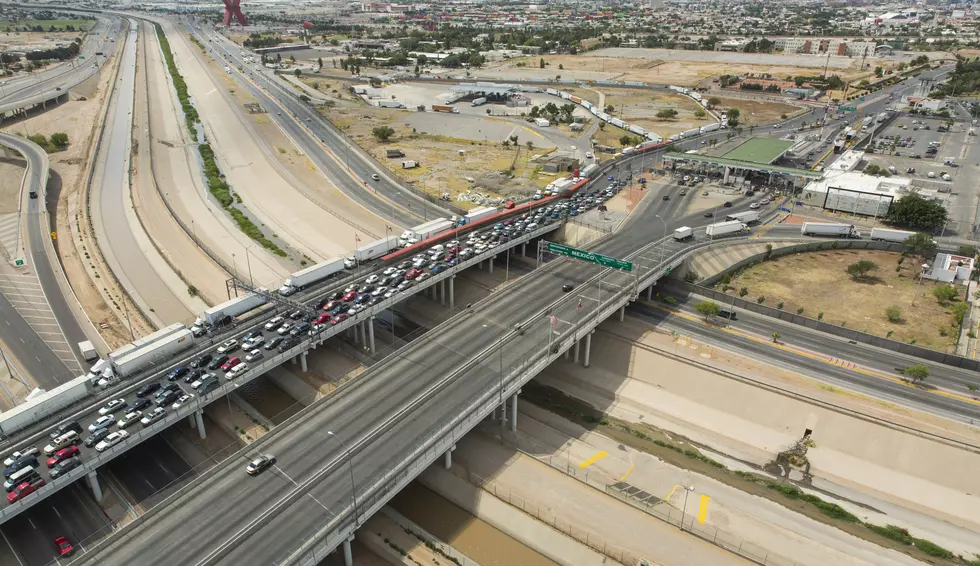
Most people who cross the Bridge of the Americas are thinking about wait times and what they're going to eat in Juarez. Very few of them know they're driving over the site of one of the most dramatic diplomatic moments in U.S.-Mexico history. Two presidents. A dynamite detonation. A handshake on top of a brand new bridge. The story of how the Bridge of the Americas came to exist is genuinely one of the most fascinating chapters in El Paso's long history as a border city.
A 100-Year Argument Over a River That Wouldn't Stay Still
To understand the bridge, you have to understand the Chamizal dispute, which is one of the most uniquely bizarre international conflicts in North American history. The Rio Grande is supposed to mark the border between the United States and Mexico. The problem is the Rio Grande kept moving. After a dramatic flood in 1864, the river shifted significantly southward, and suddenly a chunk of land that Mexico considered its own was sitting on the American side of the water. Mexico said the land was still theirs. The U.S. disagreed. And so began a dispute that would drag on for over a hundred years.
By the time the Kennedy administration rolled around in the 1960s, the Chamizal dispute had become something of an embarrassment. The Cold War was in full swing, the U.S. was worried about Mexico's relationship with Cuba and the Soviet bloc, and here was this open wound of territorial grievance sitting right on the border. Kennedy saw an opportunity to strengthen the relationship with Mexico and finally get this thing settled. Negotiations led to the Chamizal Convention of 1963, which identified 630 acres in South El Paso as El Chamizal territory and promised to return it to Mexico. It was, as historians have noted, the first time the United States ever gave inhabited land back to Mexico.

Five Thousand People Had to Move
Returning that land meant removing the people who lived on it. Five South El Paso neighborhoods sat within the Chamizal zone: Rio Linda, Cotton Mill, Cordova Gardens, El Jardin, and the southernmost blocks of Segundo Barrio. More than 5,600 residents, the vast majority of them Mexican American, were displaced from their homes to make the land transfer possible. Many of them were World War II and Korean War veterans who had used VA loans to buy their properties. Some organized and fought back, demanding fair-market appraisals instead of the tax-value buyouts the federal government initially offered. Their displacement became known in the community as the Chamizal diaspora, and it is a story that El Paso's South Side families still carry.
Two Presidents, One Detonation

Kennedy was assassinated in late 1963 before he could see the Chamizal settlement through, but his successor Lyndon B. Johnson took the baton and ran with it. On October 28, 1967, Johnson and Mexican President Gustavo Diaz Ordaz met at the border to make it official. The Chamizal Zone was formally ceded back to Mexico. A new concrete channel had been constructed to lock the Rio Grande in place so the river could never pull this trick again.
And then, in what has to be one of the most Texas ways to inaugurate anything, the two presidents walked onto the bridge together and pushed buttons that set off a dynamite blast on a holding dam, releasing the Rio Grande's water into the newly constructed channel.
After the blast, Johnson and Diaz Ordaz stood atop the bridge and shook hands. Johnson had personally named the crossing just days earlier at a ceremony, declaring: the bridge to the east joining our two countries would be called the Bridge of the Americas, because it stood as a reminder that El Paso and Juarez sat upon a major route of travel and commerce connecting two nations.
Puente Libre: The Only Free Ride in Town
Locals in Juarez have their own name for the bridge: Puente Libre, which translates simply to "Free Bridge." It is not poetic. It is practical. The Bridge of the Americas is the only toll-free crossing between Mexico and Texas, and that distinction makes it the busiest vehicle crossing in all of El Paso, handling more than half of all cars and trucks entering the city from Mexico. The infrastructure reflects that demand. What looks like one bridge is actually four separate structures running parallel: two four-lane bridges for passenger vehicles and two two-lane bridges dedicated to commercial truck traffic, with pedestrian walkways running alongside.
Hollywood Noticed Too

The Bridge of the Americas has made its way onto screens more than once. The FX crime drama The Bridge, which ran from 2013 to 2014 and starred Diane Kruger and Demian Bichir, was set entirely in El Paso and Juarez and took its name directly from the BOTA crossing. The show opened with a body discovered precisely on the borderline between the two countries, and the pilot episode was filmed right here in El Paso. Denis Villeneuve's 2015 film Sicario also featured the bridge in one of its most tense sequences, giving the crossing a cinematic profile that few pieces of infrastructure anywhere can claim.
A Bridge Built on History
Next time you are sitting in BOTA traffic, staring at the back of a semi-truck and debating whether the carnitas you are about to eat are worth the wait, consider what is underneath you. A resolved century-old international dispute. The first land the United States ever returned to Mexico. Thousands of displaced South El Paso families. The site where two presidents blew up a dam together and shook hands over a river. The Bridge of the Americas is not just a way to get to Juarez. It is one of the most historically loaded pieces of pavement in the entire country, and it belongs to El Paso.
Thomas P. Moad: 1st El Paso Officer Killed In The Line Of Duty
Gallery Credit: Grizz
Your Guide to El Paso’s Indoor and Outdoor Swimming Pools
Gallery Credit: Courtesy: elpasotx.gov
El Pasoan Secretly Hides Ducks and the Internet Loves It
Gallery Credit: Courtesy: EP Ducker
More From 93.1 KISS FM